'I only went out for a walk and finally concluded to stay out 'til sundown, for going out, I found was really going in.' John Muir

I've seen the top of Everest (from a long way off), smelled the breath of a whale (from way too close) and lived on a boat in Greece (for a few years), but I continue to experience some of my most precious moments right outside my backdoor.

If comments are proving difficult to do, please email me; sleepysparrow@yahoo.co.uk

Friday, 10 May 2013

Tales of a Rhydymwyn Riverbank


Last week, on a rare warm spring day, I joined Kate from North East Wales Wildlife on her regular otter survey route, past banks of pale yellow primroses and delicate violets.  The smell of wild garlic caused us to wrinkle our noses and talk about making wild garlic pesto sauce as the River Alyn murmured gently in the background.


Kate stopped and peered through her binoculars, ‘There’s some spraint,’ she pointed at an oily splodge on a prominent rock on the edge of the river.  We crouched over it and saw that it was full of white specks, ‘Frog leg bones,’ said Kate.  Of course we had to sniff the splodge, there’s a lot of speculation about the smell of otter poo.  Some say it’s like jasmine tea, others that it’s fishy or even like freshly mown hay, anyway, we agreed it’s not as unpleasant as it looks.  And more importantly, it meant there were otters here.  We spotted more and more spraint further along the river and then, even more exciting, paw prints in the silty mud


It was an idyllic spot on such a day, open meadow, slow meandering river, wild flowers, buzzards mewing, a woodpecker beating a frantic rhythm on a nearby dead tree.  Suddenly, we flinched at a sharp ‘peep’ and saw a blue blur as a kingfisher zipped past us.  It was tempting to take our shoes and socks off and paddle, but we were meant to be looking for otters. 
In fact, the cameras set up by NEW Wildlife have already picked up an otter and two cubs, we wanted to check if they were still around so were keen on finding fresh spraint.  The paw prints were certainly fresh and we imagined the otters scampering and playing over the many new branches fallen after the heavy April snows.  We were willing an otter to appear and kept our eyes peeled amongst the dark places under the overhanging bank and in the tangle of willow roots but we knew it was very unlikely. 
We agreed that just knowing they were around was enough.

Wednesday, 8 May 2013

Re-visiting an old backyard


Although it is my mission to appreciate and explore my own backyard, in April,the cold and snow forced me into submission.  I lived on a boat in Greece for a while where my backyard was watery and filled with dolphins.  It was time to re-visit that backyard for a couple of weeks.

Things got off to a promising start when a leather-jacketed bloke called Odysseus met us at Athens airport with our hire car. 

Greece in the springtime is sublime.  Flowers burst from every crevice, anemonies, poppies, marigolds, daisies, all mixed up and higgledy-piggledy, like one of the gods had scattered a giant packet of mixed wildflower seeds from a great height. 

                                   
We followed old cobbled paths up and up towards distant snow-capped peaks, crossed a deep, dark gorge where tall, thin cypress trees were scattered like exclamation marks. And beyond, the sea glittered, turquoise and silver and the sky was blue as the Greek flags fluttering from the taverna.


We ate Greek salads,
drenched in thick green olive oil
topped with slabs of salty feta cheese,
washed down with tongue-numbingly
cold Mythos beer. 

Our shoulders gradually slumped, we sashayed rather than scurried, felt our toes unclench and our eyes smile. It was good to be back.


Sunday, 24 March 2013

Earth Hour

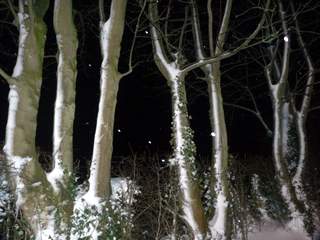
We switched off our lights and went for a walk during Earth Hour last night (8.30pm).  Snow had drifted to the height of the hedges and trees had white stripes on the exposed side of their trunks.  John's sheep were huddled in the gateway I normally lean on to view Moel Fammau.  Their eyes shone in the snow-light.  Even without a moon, we didn't need a torch to see our way.  No traffic moved.  The world was silent apart from the whistle of wind. We felt the sting of blown snow on our cheeks.  Branches of trees lolled on the ground, weighted down by layers of snow.  I wondered if they'd snap.  I saw myself going around with a big stick, liberating all the branches, like the nurse who cut off my plaster cast when I was small and made my thin white arm feel light and free again. 

When we got back home, we lit candles for the remaining 25 minutes and sat in silence, even though we really, really wanted to make a cup of tea.  The silence made my ears pop and I would swear I heard the earth around our house sigh for the relief of just an hours rest.  My ears, their tiny tubes, canals and delicate bones seemed to sigh too for their short rest.

Friday, 22 March 2013

Weed Medicine

The sun is bursting through the tall windows when I walk into the meeting room and I choose a seat directly in the path of the warming rays.  The smell of fresh coffee from Caffi Florence mingles with the nose-wrinkling aroma from a pile of wild garlic leaves on the front table.  I see from the handout that we’ll be shown how to make Ramsons Pesto sauce later.  I’m with 13 others at a Caffi Florence workshop, Loggerheads Country Park entitled; ‘ Hedgerow Remedies, Weed Medicine’.

Our tutor, Non Owen says; ‘weeds are wonderful,’ and gives us each a sample of nettle iron tonic, made in a previous session.  (From nettle tops, dried apricots, orange peel and some good red wine).  There are approving murmurs and ‘Mmms.’  ‘Tastes a bit like sherry,’ the lady next to me says, her eye-brows raised.

Non hands around a dish of dried rose hips for rose hip infused honey, telling us that they have 20-40 times more vitamin C than oranges.  There is silence as we watch the sun glint off the stream of honey Non is pouring into a pan.
         It is left to simmer whilst she moves on to Ramsons (wild garlic).  ‘It’s an antibiotic and a good spring tonic and cleanser,’ she tells us before turning on the hand blender.  We all lean back as Non switches to ‘turbo’ and prepares to lower the blender into a jug of oil and wild garlic leaves.  But it turns out to be quite tame and no-one gets covered in green slime.  Soon the liquid is the colour of a woodland and the meeting room smells like an Italian restaurant.  Non tastes it as she walks across to give us a sample.  She stops suddenly in her tracks, ‘Wooa,’ her eyes widen.  We all have a taste and experience that ‘kick’ as it slides down the back of the throat.  The room is filled with the sound of fourteen people tasting the green paste, smacking our lips, sucking in our cheeks, making sounds like appreciative cattle, ‘Mmmm.’

Meanwhile, the rose hip honey simmers on the stove and a Caffi Florence waitress comes in to take our drinks orders.
   
Next, dandelion coffee.  ’Good for the liver.’  Non prepares the dried roots and passes around the resulting pale brown liquid.  Eyes are screwed up, mouths are pursed.  It won’t be replacing my usual morning coffee, but I think of my liver and gulp it down.  

Just in time, our drinks are delivered, along with a tray of home-made cakes - lemon, fruit and chocolate brownies.  The weekly Nordic Walking Group strides past the window, their poles clicking on the path.  Perhaps they’d benefit from our next weedy remedy, a chickweed bath soak?

Finally the rosehip honey is ready.  Non decants it into small brown jars for us to take home for a vitamin C boost. 

As I leave, I can still taste the wild garlic on the back of my tongue and I see there’s Ramsons soup on the Caffi Florence menu.  Non was right, weeds are wonderful and FREE.

www.nonowenherbalist.co.uk  Medical Herbalist and Aromatherapist
www.caffiflorence.co.uk  Workshop programme


Wednesday, 20 March 2013

Slum Bird Millionaire

It’s budget day. When the chancellor opens his red box, we won’t be getting richer, times are hard.  There’s a letter from my bank saying thanks for lending us all your money but we’re now going to give you less for it.  Sorry, but times are hard. 
Today is World Sparrow day and times are hard for house sparrows too.  Their numbers have fallen by 70% in the UK, but they are in decline all over the world. 

I read a headline in a newspaper on line, ‘Homeless in Mumbai.’  It wasn’t referring to humans but to the plight of house sparrows.  The article told how conservationist Mohammed Dilawar has designed artificial nests and feeders so that the vanishing sparrows return to Mumbai.  He was also the man instrumental in declaring March 20th World Sparrow Day.   
The authorities in Delhi have adopted the house sparrow as the state bird in a bid to halt any further decline in their numbers.  ‘We will take steps to ensure that the sparrow returns, feels safe and is able to live peacefully in the city,’ said a Chief Minister.  What a noble undertaking.  All over India, people are being encouraged to ‘chirp for the sparrow’ and become ‘sparrow supporters.’ You can read their poems and stories about sparrows on the web site www.worldsparrowday.org .

Birds are major indicators of the health of our environment, which is why people spend so much time and energy monitoring, counting and ringing them.   If a bird once so common is now in such serious trouble, something’s out of kilter out there.  Their drastic decline has to have an impact on us. 

Male sparrow in the box on the end of my house
I switch on my TV, not to see what comes out of the Chancellor's red box, but to see what’s going on in the bird box on the end of my house.  The sparrows are busy.  Their nest is coming along nicely.  He flies in with a piece of dry grass, faffs and fiddles, pushing it into place with his beak. 

 She appears at the entrance with a feather and he flies off, squeezing past her.   Sometimes they don’t bring any material into the nest, just fix and tidy what’s already there, forcing the scratchy grass into a soft circle by turning their plump bodies around and around.  

One in, one out


I hope bird boxes don’t count when it comes to the bedroom tax because I have ten.  They are all occupied though.
Charlie has been meaning to re-cement the ridge tiles, too late Charlie!


Sunday, 17 March 2013

Slow Saturday Night

In my continuing quest to explore locally and do ‘slow’ things, I wonder what I can do on a soggy Saturday night in a Slow town like Mold?  Celebrate Wales' epic win of the Six Nations Rugby Tournament perhaps?  Not slow enough.   I decide to go to Theatre Clwyd and listen to some poetry by Gwyneth Lewis, Wales' first National Poet and the woman who composed those huge words outside the Wales Millenium Centre.
Heavy coats glistening with rain are hung over the backs of blue velvet chairs.  I seem to be the only one with a plastic cup of Rioja and a note book.  Gwyneth appears in a tight red dress, tinted glasses, a snazzy slash of red in her stylish, silvery hair.  She thanks us for making the effort to come after the big game and begins with a poem about swallowing the moon.  Next she reads from Sunbathing in the Rain, her cheerful book about depression and we hear how the noise of snowflakes disturbs fish.  I discover we share a love of sparrows as we are treated to poems from ‘The Sparrow Tree’ and as if I wasn’t won over already, I find Gwyneth also sails. 
The Rioja has gone down well and the hems of my trousers are drying out nicely by the time I get my copy of Sunbathing in the Rain signed.   I feel really uplifted and head out into the rain grinning, my new book tucked under my jacket.  Gwyneth was fab and I’m pleased I had the opportunity to hear her in my home town. 
This event was part of the Flintshire Arts Fest.  I could go and listen to Jazz singer Clare Teal next Tuesday.  According to Michael Parkinson she’s ‘worth listening to.’  Or, if I'm brave enough, go to the painting workshop with Ronnie Drillsma who says; ‘Good things can develop from happy accidents.’  I like doing ‘slow’ things and Flintshire’s a great place to do them in.

Wednesday, 6 March 2013

Something to Smile About

It’s said that Prince Llewelyn never smiled again after he killed his faithful hound Gelert.  He returned from a hunting trip to find his baby son missing from his cot and the dog covered in blood.  He plunged his sword into Gelert but the dogs yelps caused the baby to cry.  When Llewelyn found the boy safe and a huge wolf dead nearby he realized he’d made a dreadful mistake.

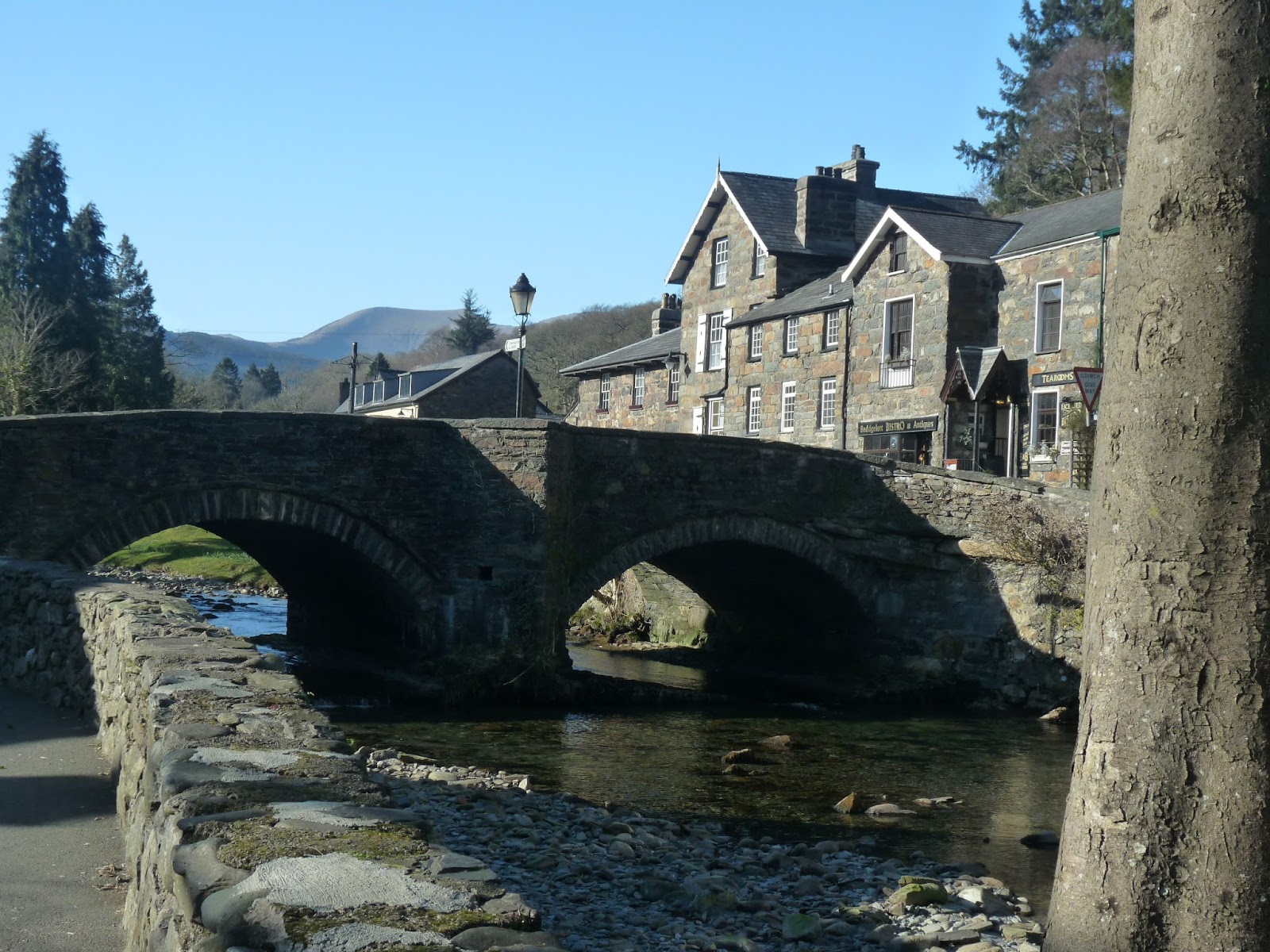
The only mistake we make when we visit Beddgelert this weekend is not staying longer.  We walk alongside the bubbling River Glaslyn past Gelert’s Grave and over the bridge that carries the Welsh Highland Railway from Caernarfon to Porthmadog, linking up with the Ffestiniog Railway.  It is now possible to travel 40 miles through this legend-filled land by steam train.  That journey goes on my wish list.

We stumble along the boulder path between the railway line and the River, crossing the sort of bridges trolls might live under.  The Glaslyn, which comes to life on Snowdon’s flanks, pours over mossy rocks, slowing down to form deep grotto-green pools.


Blue-black ravens ‘kronk-kronk’, distracting us just as the path reaches out over the foaming river. Holding on to metal rungs we edge around the sticking-out cliff face.  The sun glows on the water like there’s Welsh gold in the river bed.  


The gorge becomes narrower and we loose the sun.  The trail is edged with pale, crispy lichens, cushions of dark green moss and dripping fern fronds, like a path through a fairy tale.  Above us the sky’s the same colour as the blue-tits who flit in and out of silver birch trees and behind us is the humpy line of the Nantlle Ridge, like a pod of arching whales. 
  
After two miles, we arrive at Aberglaslyn Bridge and eat cheese sandwiches on a fallen tree trunk, edging further and further along it as the sun moves down below the cliff.  Before they built The Cob at Porthmadog, the sea used to reach this far inland and ships once tied up here. 
Somewhere nearby is an osprey’s nest with a camera and viewing place.  The birds return from Africa sometime in March. We keep our eyes peeled, just in case.


It’s dark by the time we head back to our campsite in the forest.  The last time I remember being struck dumb by the night sky was on a school visit to the Planetarium but it was spoiled by kids flicking sweet papers and giggling in the dark.  No giggling this time, just deep sighs and thousands and thousands of stars, some faint, some bright and flickering, with hardly any space between them.   Eventually I get dizzy and cold (it’s minus two degrees centigrade) and head for our snug campervan.  When I close my eyes under a mound of quilts, I can still see the stars and unlike Prince Llewelyn, I fall asleep with a great big smile on my face.  


Tuesday, 19 February 2013

Traditional Skills - Day Two

The weather’s no better but we’re raring to go.  Naomi takes us through the process of making ‘burn’ spoons.  Somehow we’re going to turn a sycamore log into a wooden spoon!
      ‘There’s a big fire burning outside,’ she grins. 
      ‘Er, it’s not that big yet,’ Dan pokes his head around the door.

Naomi tells us some important tree etiquette.  ‘When you cut down a tree don’t leave the pale stump exposed, show it some respect and rub it with mud.’  I like that, helping the tree maintain its dignity.

We saw a piece of sycamore, split it, draw a spoon on the split side and gather around the fire pit for another demo. 
Using tongs made from willow, we select a piece of red hot ember, and after chasing it around the fire pit, sticking our tongues out like children concentrating hard, we eventually manage to pick it up and balance it on what will be the bowl of our spoons.  Holding the ember in place with a stick, we blow – hard, to create heat.  ‘Don’t hyperventilate,’ Dan warns, as I start to see stars from blowing too much.  Eventually, shallow indentations are miraculously made.


Inside in the warm, we begin whittling our spoons.  We sit well apart from each other so there are no nasty accidents. Dan explains the technique, ‘No carving on your leg.’  We all wince at the image he creates should the knife slip.
For a while, there’s just a scrape, scrape sound and the buzz of the overhead heaters as we all focus on our spoons and a mound of shavings grows at our feet.  We don’t want to stop for tea, we’re all getting ‘spoon vision’ according to Dan.

After lunch there’s a choice of making raw hide pouches or carrying on whittling our spoons.  Me and Dad choose to continue with our spoons. 
By the end of the day, I’m doubtful whether I’ll be peeling spuds for a while but we’re delighted with our rustic cutlery.

Sunday, 17 February 2013

Up with the lark

The wind’s from Siberia, slicing through the crystal clear sky like an ice axe.  We’re up on Halkyn Common, Snowdonia on our left, The Dee far below on our right. I hear a faint song, like a thumb being drawn continuously over the teeth of a metal comb - not a dunnock, not a robin. Pulling my fleece hat off my right ear, I angle my head away from the whistling wind and look up.  Finally I spot a black dot way up high, just in front of the tissue paper moon, underlined by an EasyJet vapour trail, my first skylark of the year.  He pours down his song, never pausing for breath. 
It's only February, he won’t breed until April but he’s making sure he gets the best territory– the birdie equivalent of spreading his towel on a sun lounger before breakfast.

There's a ‘gulp’ of magpies clattering in a scrawny hawthorn.  I pity the ground nesting lark, though I once walked past a skylark’s nest everyday for a month and never knew it was there until someone showed me.  They’re very good at leading you away from their chicks.  Can they fool the magpies though?

Saturday, 16 February 2013

Small Signs of Spring


Rhubarb!


Traditional Skills in Rhydymwyn

It’s Saturday, the weather’s grim, perfect for staying in and watching the rugby.  But Me and my Dad are busy turning a deer’s shin bone into a needle.  We select a bone, score it with a piece of flint, hit it with a stone to break it into shards then pick one to file into a needle.  Real cavemen would’ve used sandstone to file their bone bits, we haven’t got all day so we cheat with metal files.  The workroom is filled with the sound of rasping files and thirteen people concentrating hard, not even stopping for tea when Dan shouts; ‘the kettle’s boiled.’  It’s very meditative, filing.  Your mind is focused on the job in hand, the rain, the rugby, the chores are far away.
In the middle of it all, Naomi throws out a question:  ‘The weight of all the insects on the planet would be more than the weight of all the humans, true or false?’   Quick as a flash, someone shouts out, ‘True,’ and is rewarded with a parcel wrapped in Rudolph the Reindeer paper - a selection box!  The rest of the day is punctuated with sudden random questions and winners are rewarded with more chocolate. 
Deer Bone needles and awls

Naomi and Dan are www.outback2basics.co.uk from Shropshire.  They've been invited by North East Wales Wildlife (www.newwildlife.org.ukto teach us some traditional skills. They’re brilliant, passionate, but most of all, fun.  They went to America and re-lived the Stone Age for 4 months, making their own clothes, shoes, shelter, fire, food.  We saw the photos, they obviously didn’t have showers in the Stone Age.


After lunch, we go outside for some fresh air and learn how to tap a birch tree to get the sap.  ‘It makes a lovely drink,’ Dan says.  ‘Pine cones make great scrubbing brushes,’ adds Naomi,  ‘and those Leylandii we all hate in our neighbour’s gardens, their bark makes great containers, but get permission first before you go stripping the bark of your neighbour’s trees, or any trees.’ 
            On our way back to the workroom, we stand under a dripping birch tree and study its branches.  ‘How can you use a tree to find your way?’ asks Dan.
 ‘Er, we give up.’  Dan explains that the branches on the south side of the tree are more horizontal, pointing towards the sun, the branches on the north side have to find the light so they point up, towards the sky.  Easy!


Bark Containers


Back inside, we begin making bark containers, sort of Stone Age handbags.  And we use the needles and awls we made during the morning session.  By the end of the afternoon, we’ve made an amazing variety of bark ‘bags.’  Better than Louis Vuitton any day.

Me and Dad walk home proud as punch with our bone needles, bark containers and chocolate prizes.  We stop by a particularly fine silver birch tree; ‘Nice bit of bark,’ says Dad.
            ‘Hmmm,’ I reply, stroking the trunk and picturing my next rustic creation.

(This was a free course provided by NEW Wildlife based in Rhydymwyn)

Wednesday, 6 February 2013

Slow Saturday

I live near Mold.  It’s a ‘Slow Town’.  So I decide to do something ‘slow’.
I phone my friend. ‘How do you fancy a walk followed by coffee and homemade cakes?’   
‘Count me in,’ my friend’s a big cake fan.
We head for the village of Cilcain where every Saturday afternoon there’s a community café in the village hall. (www.cilcaintoday.org.uk)
 If there’s one thing I like as much as homemade cakes, it’s second hand books.  On the way in to the village hall, there’s a table piled high with them, impossible to pass.  After a leisurely browse, I select a book about mosaics and my friend finds one about Shackleton’s epic voyage.  We put our money in the honesty box and follow the tinkling sound of teaspoons on china. 
The hall is laid out with half a dozen gingham covered tables. My eyes come out on stalks as we approach the huge serving hatch and I take far too long choosing a cake. A queue builds up behind me but everyone understands my dilemma and waits patiently whilst I chose from chocolate, lemon, apple, fruit, brownie or flapjack. 
The café has a different theme each week.  Today there are crafts made by local people.  I chat to a woman who makes fabulous notebooks, cufflinks, earrings, cards, and art work from old newspapers and books.  ‘Everyone calls me the newspaper lady,’ she laughs, ‘people have started bringing me foreign newspapers and old menus from their holidays.’   I buy a beautiful blue-washed bookmark. You’d never guess it was made from old newspapers. 
On our way home along the quiet lanes I hear a familiar sound but one I haven’t heard for ages and I just can’t place it.  ‘What is that?  It’s like one of those swannee whistles that clowns blow when their trousers fall down.’ I hear it again and shout ‘Lapwing!’  We look over the hedge into a flooded field and see six.  I raise my binoculars, which have been around my neck all through coffee and cake.  Not a good idea.  I clean off the crumbs and look again.  There’s something about the cry of a lapwing which stirs the heart and makes me think of the wild moors and far off places yet here they are, on my walk home, taking advantage of the soggy field to probe for worms and insects.  Two take to the air, flapping their broad black and white wings and repeating that funny pee-wit call. 
A couple of lanes further on something zooms out of the wood just ahead of us, ‘Woodcock,’ we both shout together.  It zigzaggs up the field towards another bit of wood, its long bill pointing the way.
Red streaks appear in the darkening sky as we approach home.  ‘I could get to like this,’ my friend beams, ‘let me know if you plan any more slow outings.’

Sunday, 3 February 2013

Midweek Treat


The wind is blowing hard, blue tits cling on to wildly swinging feeders, crows like black rubbish bags swirl through the grey sky.  It’s the perfect day for a full body Swedish massage. 

The health and beauty students at Deeside College practice their newly learned skills on us lucky locals for a fraction of the money we’d pay in a salon (£8 for full body massage).  The atmosphere is calming, the lighting soft and the students are very professional.

I’m wrapped in a warm blanket and with soothing music playing in the background, the massage begins.  I ask for firm pressure, my shoulders are in a mess from getting my garden ready for early potatoes.  Apart from turning over, I don’t move, I’m made of lead.

An hour later, I’m given a glass of water and left to get dressed in my own time.  Sally tells me to take it easy for the rest of the day, drink plenty of water and eat a light meal.
      ‘If you put a tennis ball in a sock and lean on it against a wall, rolling it over your back, it will help your tense shoulders,’ she advises.  Great idea. 
     I float down to reception and book another treatment, Hot Stones in two weeks time. (I've had this before, it's sublime).  I could've gone for reflexology, a facial, pedicure, manicure or Indian Head massage. Last week I had my haircut for £4.

What a treat and practically on my doorstep. Check out your local college to see what’s on offer,  you may be surprised!

Back at home, I follow Sally's advice and put my feet up.  I'm impressed watching a robin pull worms from my newly dug potato patch, I can hardly lift my mug of herbal tea.

Saturday, 19 January 2013

Bird Breakfast Blizzard

Big wet flakes swirl all around me as I carefully carry the breakfast tray across the garden.  It’s hard to find a snow-free spot to scatter left-over mince pies, chopped apple, sultanas and seed.  'Blackie's beady eyes watch me from beneath the buddleia, the flash of his yellow beak provides the only colour today.  A whiff of summer from the apple is carried away in a blizzardy gust.  I sprinkle bird-breakfast and scurry back in doors.
Five more blackbirds arrive and I’m glad I chopped the apple up small. Siskins, goldfinches, chaffinches, dunnocks, sparrows, starlings, a song thrush, coal-tits, blue-tits, great-tits, all jostle for space.  Even birds that don’t normally hang onto seed feeders are having a go, a starling tries, a dunnock too, and then a robin flutters his wings wildly as he tries to grab on to the swinging seed.

Goldfinches!  You'd think to look at them that butter wouldn't melt, yet they are so narky and quarrelsome and the shrill, grating sound they make is not at all what you'd expect from such a glamorous looking bird. 

Another bird came to visit my garden last week. 
I Googled her and discovered she was a Reeve's pheasant. 
Her markings were so beautiful.  She clattered down from the fence and ran towards me.  I gave her seed from the large sack in my shed.  She stayed all afternoon, admiring herself in the glass of the patio doors, then left.  I heard shooting from the estate nearby and hoped she hadn't headed that way.

Sunday, 13 January 2013

Top Secret Birds!

At the end of my road there’s a strange collection of old brick buildings, paths covered with a now peeling anti-spark coating,  an old railway siding and some deep underground tunnels.   It was once a top secret WW2 chemical weapons factory and the tunnels held thousands of mustard gas shells.  They also carried out research into the first atomic bomb here.  Calculations and scribblings can still be seen on the walls in some of the buildings.  But now it's a thriving nature reserve and home to North East Wales Wildlife and Rhydymwyn Valley History Society.

I was on site to help out with a winter bird survey.  It was freezing , the golden reeds were covered in frost, the trees stood out like pencil sketches against a pale, water-colour-wash sky and my breath billowed out in clouds through my red felt scarf.

Jackdaws repeated their harsh calls like the sound of ice cracking; we counted their black shapes in the spooky ash tree.      On hearing a bright tinkling sound we looked up and counted ‘1, 2, 3, 4………10 goldfinches.’  We watched them disappear, showing off their light, bouncy flight.  Blue-tit, coal-tit, robin, wren, dunnock, marsh tit at the feeders in front of the bird hide, fieldfares clattering overhead, we counted them all until it was time for lunch and much needed hot chocolate.

After lunch we walked the Woodland Trail.  It was slightly warmer up there, less frost.  The branches glittered with drops of moisture and our feet slithered on dark slimy leaves.  The air was heavy, still and silent except for a drip-dripping sound and the occasional crunch of twigs under foot.   Then we heard a noise like tiny football rattles and saw a troupe of long-tailed tits swinging through the branches.   Then, the ‘demented’ call of a nuthatch, the thin ‘tsee’ of a goldcrest high in a conifer and the ‘squeaky toy’ sound of a great-spotted woodpecker.   Someone whispered, ‘There’s a treecreeper,’ and we all looked up to see the tiny bird, doing exactly what it says on the tin.

‘Woodcock!’ We shouted, looking at each other for confirmation that we hadn’t been imagining it. 
  It was on the edge of the Woodland Trail hiding in the leaf litter, until we approached with our clip boards.  I had a quick glimpse of its stocky body and long dagger bill before it disappeared. 

Kate pointed out some King Alfred’s Cake fungus, hard, oval and shiny black, growing on the bark of a dead tree.  She told us how it can be used to light a fire.  I never knew that.  I also never knew that I could see woodcock just down the road from my house.  I always imagined I’d have to get in the car and drive to a deep, dark wood somewhere miles away. 
Oh and there was also a ‘possible snipe’ near the wetland, but that flew off so quickly that none of us could be 100% sure.  

The next winter bird survey is on Saturday 26th January. I’m going to do my best to be there.  Who knows, we might see a ‘definite snipe’ this time?