'I only went out for a walk and finally concluded to stay out 'til sundown, for going out, I found was really going in.' John Muir

I've seen the top of Everest (from a long way off), smelled the breath of a whale (from way too close) and lived on a boat in Greece (for a few years), but I continue to experience some of my most precious moments right outside my backdoor.

If comments are proving difficult to do, please email me; sleepysparrow@yahoo.co.uk
Showing posts with label Rhydymwyn. Show all posts

Saturday, 1 February 2014

Hidden Kingdoms - in Rhydymwyn

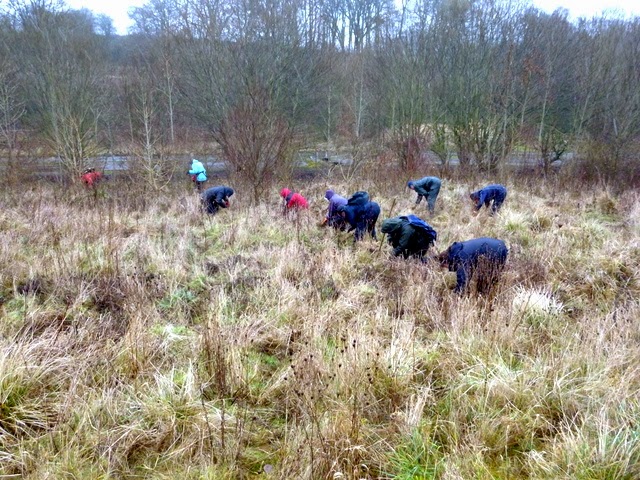
It was like a scene from one of those dark crime dramas on telly.  We lined up, a meter apart and began systematically combing through the rough grass, parting the soggy tussocks with wet gloves, searching for clues, like a police forensic team.  Falling sleet and a raven's hollow 'kronk' added to the crime thriller atmosphere.
A scene from Silent Witness?
 
But we weren't looking for anything gruesome, just the golf-ball sized nests of the harvest mouse, Europe's smallest mammal.  The mouse is no bigger than a wine cork,weighs the same as a 20 pence piece and is the only mouse with a prehensile tail for clinging on to the stems of wheat and tall grasses.
Non-breeding harvest mouse nest, custard cream for scale
They are seriously under-recorded and the Mammal Society need volunteers to survey for nests during the winter of 2014. We were gathered on this finger-numbing day to learn how to look and what to look for. Winter is the best time to search so as not to disturb their breeding and because they are easier to find. 
Needless to say, we didn't find any, though someone did find a golf ball in the long grass. Never mind, we found lots of vole nest, tunnels and latrines and it was wonderful to get a vole's eye view of the world and glimpse a tiny bit of their lives. Thankfully there were no kestrels hovering nearby
If you've enjoyed watching Hidden Kingdoms on BBC1, get involved in a harvest mouse survey and catch a glimpse of the hidden world in a field near you.

www.mammal.org.uk/harvestmouse_survey (The Mammal Society)
www.miseproject.ie   (Mammals in a Sustainable Environment)
  

Tuesday, 12 November 2013

Postcard from the riverbank


The River Alyn flows through my patch, at least it does until the summer or when there’s less rain.  Then it flows under my patch.  It’s swallowed up by great yawning caverns, old lead mining tunnels and natural limestone fissures.  I’m always sad to see it go.  One minute it’s murmuring along at my side and the next day just a few silent pools remain.  I’ve never seen a kingfisher or a dipper on my stretch of the river but I’ve seen them upstream and downstream where the river stays at the surface.

After the heavy rain we’ve had recently, the River’s back and I hope so are the otters. I join Kate from North East Wales Wildlife to look for signs. 


The sky’s the blue of a jay’s wing feathers.  We walk along the squelchy banks, sinking into cattle trodden mud and slithering over sycamore leaves.  When we reach the holt and the camera, Kate scrambles down and removes the memory card to check later.
I love this section of the River.  The woodland opens out into a meadow and today the trees glow and the river fizzes and sparkles like someone’s dropped a crate of alka-seltzer tablets into it.
 
 
I turn from admiring the amber view and see Kate stooping over some otter spraint on a lump of limestone.  She points out tiny fishy vertebrae in the oily splodge.  We mark the place on the map, photograph the poo and amble on.

Coming around a bend in the river, we disturb a female goosander.  She hurries skywards leaving trail of water droplets hanging in the air like pearls.

At the foot bridge we find more spraint. Kate tells me about the otter slide she discovered here earlier this year when the snow was thick on the ground.  She said it looked like they’d been sliding down the steep bank and plunging into the river over and over again.   We stand at the spot imagining an otter water park.
On the other side of the River is an old willow with one branch leaning right across the water, a perfect play tree for otters.  We find more spraint.  There are definitely otters here then, and even though we don’t see them, just knowing they are around is exciting.
 
 
Back in the office with mugs of tea, we hunch over the computer screen to watch the footage.  The camera is triggered by movement.  The computer shows that it’s been triggered many times. But when we watch we see we’ve been out foxed by a fox - a badger, an annoying bit of Himalayan Balsam blowing in the breeze... and a bouncing Jay with sky blue wings.

I've a feeling we'll have more luck with the camera on our next survey...

The next otter surveys are on:
Tues 19th and Wed 27th November 2013.

www.newwildlife.org.uk
www.rhydymwyn-hendre.org

Sunday, 21 July 2013

Abracadabra!

There’s magic afoot in my village......

My hands are blue but not because I’m cold.

I proudly peg my beautiful (well, I think so) creations on the line strung out between the birch trees.  They drip drip alongside, vests, sheets, pillow cases, skeins of wool and squares of material  all dyed the indigo blue of a late night summer sky just before the first stars appear.  But each piece has a unique pattern, swirls of white, tiny neat squares, straight lines, zigzags, little round circles and these patterns were created by MAGIC!


Marietta welcomes eight of us to her Indigo Dyeing Workshop run by NEW Wildlife at Rhydymwyn with a promise that we’ll each take home something unique at the end of the day.  We ogle at her fabric samples printed with intricate patterns and look at the array of pegs, rubber bands, string and even a bag of dried chick peas and I for one doubt that I’ll transform my plain white t-shirts into something so blue and beautiful.
She makes up two buckets of dye and demonstrates how we can create patterns on our fabric, then we begin – pleating, pegging, tying, scrunching, wrapping.  We become more creative as we get into it and wrap pine cones, pebbles and even the puzzling chick peas into our fabric.


Chick Pea patterns

Outside in the sunshine, with bees buzzing, a woodpecker pic-pic-ing and swathes of yellow loostrife lighting up the outside workspace, we squat before the buckets of dye and dip our pegged, paper clipped and chickpea-ed items into the liquid.  After 5 minutes we lift them out.  They are yellowy-green but - ‘hey presto’, as soon as the air hits them, magic occurs and they turn indigo before our amazed eyes.  More magic happens when we remove the string, pegs, pine cones, etc to reveal beautiful patterns.


Watching our creations flutter in the warm breeze I think; Harry Potter couldn’t have done better on his first day at Hogwarts.


Friday, 10 May 2013

Tales of a Rhydymwyn Riverbank


Last week, on a rare warm spring day, I joined Kate from North East Wales Wildlife on her regular otter survey route, past banks of pale yellow primroses and delicate violets.  The smell of wild garlic caused us to wrinkle our noses and talk about making wild garlic pesto sauce as the River Alyn murmured gently in the background.


Kate stopped and peered through her binoculars, ‘There’s some spraint,’ she pointed at an oily splodge on a prominent rock on the edge of the river.  We crouched over it and saw that it was full of white specks, ‘Frog leg bones,’ said Kate.  Of course we had to sniff the splodge, there’s a lot of speculation about the smell of otter poo.  Some say it’s like jasmine tea, others that it’s fishy or even like freshly mown hay, anyway, we agreed it’s not as unpleasant as it looks.  And more importantly, it meant there were otters here.  We spotted more and more spraint further along the river and then, even more exciting, paw prints in the silty mud


It was an idyllic spot on such a day, open meadow, slow meandering river, wild flowers, buzzards mewing, a woodpecker beating a frantic rhythm on a nearby dead tree.  Suddenly, we flinched at a sharp ‘peep’ and saw a blue blur as a kingfisher zipped past us.  It was tempting to take our shoes and socks off and paddle, but we were meant to be looking for otters. 
In fact, the cameras set up by NEW Wildlife have already picked up an otter and two cubs, we wanted to check if they were still around so were keen on finding fresh spraint.  The paw prints were certainly fresh and we imagined the otters scampering and playing over the many new branches fallen after the heavy April snows.  We were willing an otter to appear and kept our eyes peeled amongst the dark places under the overhanging bank and in the tangle of willow roots but we knew it was very unlikely. 
We agreed that just knowing they were around was enough.

Saturday, 16 February 2013

Traditional Skills in Rhydymwyn

It’s Saturday, the weather’s grim, perfect for staying in and watching the rugby.  But Me and my Dad are busy turning a deer’s shin bone into a needle.  We select a bone, score it with a piece of flint, hit it with a stone to break it into shards then pick one to file into a needle.  Real cavemen would’ve used sandstone to file their bone bits, we haven’t got all day so we cheat with metal files.  The workroom is filled with the sound of rasping files and thirteen people concentrating hard, not even stopping for tea when Dan shouts; ‘the kettle’s boiled.’  It’s very meditative, filing.  Your mind is focused on the job in hand, the rain, the rugby, the chores are far away.
In the middle of it all, Naomi throws out a question:  ‘The weight of all the insects on the planet would be more than the weight of all the humans, true or false?’   Quick as a flash, someone shouts out, ‘True,’ and is rewarded with a parcel wrapped in Rudolph the Reindeer paper - a selection box!  The rest of the day is punctuated with sudden random questions and winners are rewarded with more chocolate. 
Deer Bone needles and awls

Naomi and Dan are www.outback2basics.co.uk from Shropshire.  They've been invited by North East Wales Wildlife (www.newwildlife.org.ukto teach us some traditional skills. They’re brilliant, passionate, but most of all, fun.  They went to America and re-lived the Stone Age for 4 months, making their own clothes, shoes, shelter, fire, food.  We saw the photos, they obviously didn’t have showers in the Stone Age.


After lunch, we go outside for some fresh air and learn how to tap a birch tree to get the sap.  ‘It makes a lovely drink,’ Dan says.  ‘Pine cones make great scrubbing brushes,’ adds Naomi,  ‘and those Leylandii we all hate in our neighbour’s gardens, their bark makes great containers, but get permission first before you go stripping the bark of your neighbour’s trees, or any trees.’ 
            On our way back to the workroom, we stand under a dripping birch tree and study its branches.  ‘How can you use a tree to find your way?’ asks Dan.
 ‘Er, we give up.’  Dan explains that the branches on the south side of the tree are more horizontal, pointing towards the sun, the branches on the north side have to find the light so they point up, towards the sky.  Easy!


Bark Containers


Back inside, we begin making bark containers, sort of Stone Age handbags.  And we use the needles and awls we made during the morning session.  By the end of the afternoon, we’ve made an amazing variety of bark ‘bags.’  Better than Louis Vuitton any day.

Me and Dad walk home proud as punch with our bone needles, bark containers and chocolate prizes.  We stop by a particularly fine silver birch tree; ‘Nice bit of bark,’ says Dad.
            ‘Hmmm,’ I reply, stroking the trunk and picturing my next rustic creation.

(This was a free course provided by NEW Wildlife based in Rhydymwyn)